What is a forward deployed engineer, and how do FDEs handle clients?
A forward deployed engineer (FDE) is a software engineer who works inside a customer's organization to make a product solve that customer's real problem. Half of the job is engineering. The other half is people: finding who decides, running discovery, keeping notes from every visit and following through on every promise. This page explains the role and the client work behind it.
What is an FDE? The FDE role and what an FDE engineer (forward deployed engineer) does
FDE stands for forward deployed engineer, so an FDE engineer is the same job, often searched that way. The title comes from Palantir, which has long sent engineers to work on site with customers. Since 2025 AI companies such as OpenAI and Anthropic have built FDE teams to take models into production at customer companies. The FDE role runs from a customer problem to a working deployment: scope the problem with the customer, build and integrate the solution, and carry what they learn back to the product team. For example, an FDE placed at a logistics customer might spend Monday in a workshop with the operations lead, Wednesday wiring the model into the dispatch system and Friday writing up what the product team should build next. Mars keeps what each person said that week on their own page, so the Friday write-up quotes the customer instead of memory. Read an FDE role posting the same way: lines such as "own deployments end to end" and "present to customer leaders" are the client half, and "Python, SQL, APIs" is the engineering half; interviews test both. If you are still asking what is an FDE, start with the message that used the word: a recruiter writes about "an FDE opening on the applied AI team". Share it with Mars and ask what the role involves; Mars lists the customer duties and the engineering duties the message names and the questions to ask on the first call, and in IT security, where FDE can mean full disk encryption, it says so.
- Works with one or a few customers at a time, often on site
- Writes production code and integrations, not slide decks
- Turns customer problems into product feedback
Forward deployed engineering: the delivery model, and when a company should adopt it
Forward deployed engineering is the practice behind the role: instead of handing a product to a customer and waiting for their team to integrate it, a vendor puts its own engineers inside the customer until the product works in production there. Palantir built its business this way, and AI companies adopted it because a model that does well in a demo still has to be wired into each customer's data, permissions and workflows. It differs from consulting and professional services in where the work goes: an FDE team writes code against the product, and what it learns at one customer becomes a product feature for the next. For example, an AI vendor whose pilots keep stalling at integration places two forward deployed engineers with one bank for eight weeks: they map who signs off, sit with the compliance team, connect the model to the case system and report which steps the product should automate. Mars keeps each person the team meets on their own page, with what they asked for and what was promised, so the next engineer at the same bank starts from that record instead of from zero.
- Adopt it when each customer's data, systems or rules differ enough that self-serve setup stalls
- Skip it when the product works out of the box: the cost per customer is high
- Measure it by time to production and by how much of each deployment becomes reusable product
Forward deployed engineer vs software engineer vs solutions engineer, how to become a forward deployed engineer, and Anthropic's FDE path
A software engineer builds the product for all customers. A solutions engineer supports the sale with demos and technical answers. A forward deployed engineer owns delivery after the sale: they build inside one customer's systems until the result is live, so they spend far more time with customer stakeholders than either. That is also the usual way in: most FDEs come from software, data or solutions engineering and add the half they lack. A software engineer adds discovery and writing for non-engineers; a solutions engineer adds production code, APIs, SQL and, for AI companies, retrieval, agents and evaluation. Hiring teams then want proof of both, such as two or three projects deployed for a real user, and FDE interviews often add a case breakdown and a discovery role-play. For example, before you apply, book short calls with five working FDEs. Mars keeps a page for each of them with what they said about the role, prepares a brief before each call and reminds you to send the follow-up you promised, which is the same client discipline the job asks for. If you are a software engineer weighing a switch, compare the weeks, not the titles: a software engineer spends most days in one codebase on one team's roadmap, while a forward deployed engineer spends much of the week with one customer, often on site, writing code that must run in their systems and explaining it to people who are not engineers. Debugging, APIs and data work carry over; discovery, stakeholder updates and written handovers are what you add. If you are following the Anthropic forward deployed engineer path, there are two separate routes. Anthropic hires its own forward deployed engineers through ordinary job postings on its careers page, such as Forward Deployed Engineer, Applied AI. In October 2026 it also launched Claude Frontier Academy, whose first program, the Frontier Deployed Engineer Residency, trains engineers who already work at Anthropic's customers and partners: their employer nominates them, they do a three-day in-person intensive and then a 12-week residency leading a real Claude deployment at their own company, and those who pass the final assessment earn the Claude Frontier Deployed Engineer badge, the first expected in early 2027. Individuals cannot apply to the residency on their own, and Anthropic presents it as training for customer and partner engineers, not as hiring for its own team. For example, an engineer whose company is rolling out Claude asks their manager about a nomination and joins a call with the Anthropic account team. Mars keeps what the manager and the account team said on their own pages and reminds the engineer of the follow-up they promised.
- Software engineer: one product, many customers
- Solutions engineer: pre-sales, demos and proofs of concept
- FDE: post-sale delivery and production results for a specific customer
- Path in: add the missing half, then show two or three real deployments
- Anthropic path: apply to its own FDE openings, or get nominated by your employer for the Claude Frontier Academy residency
Stakeholder mapping: who decides, who uses, who can block
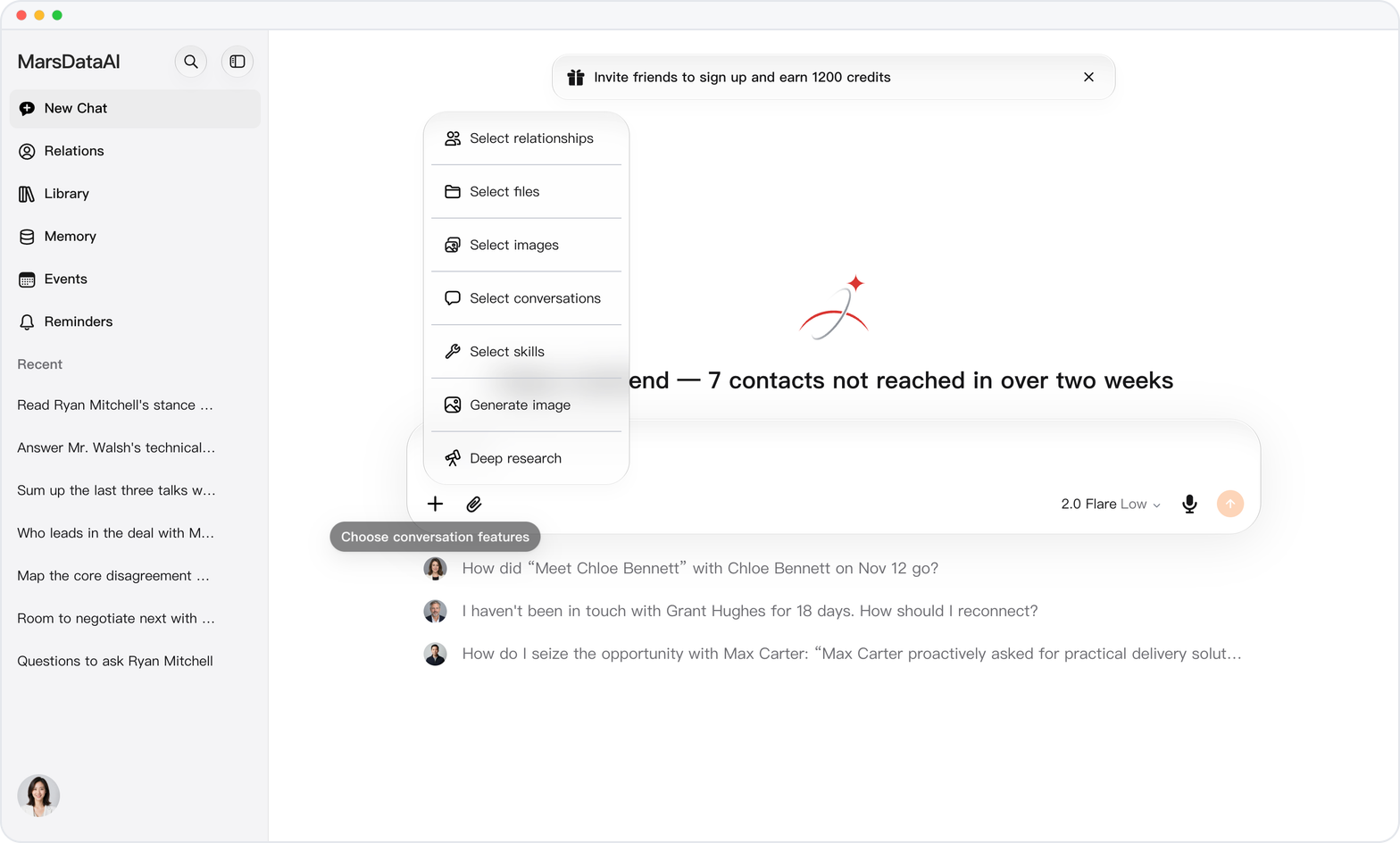
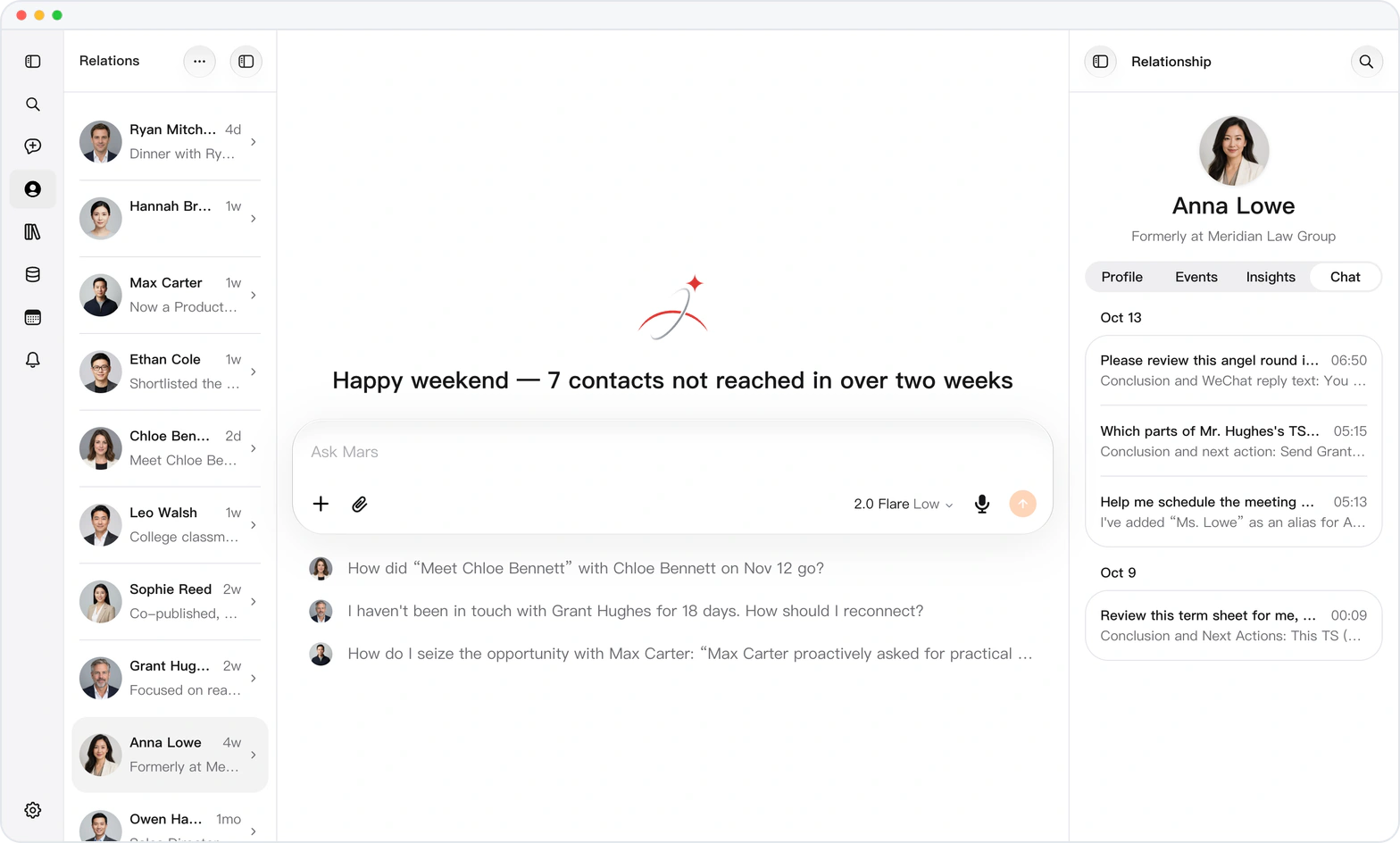
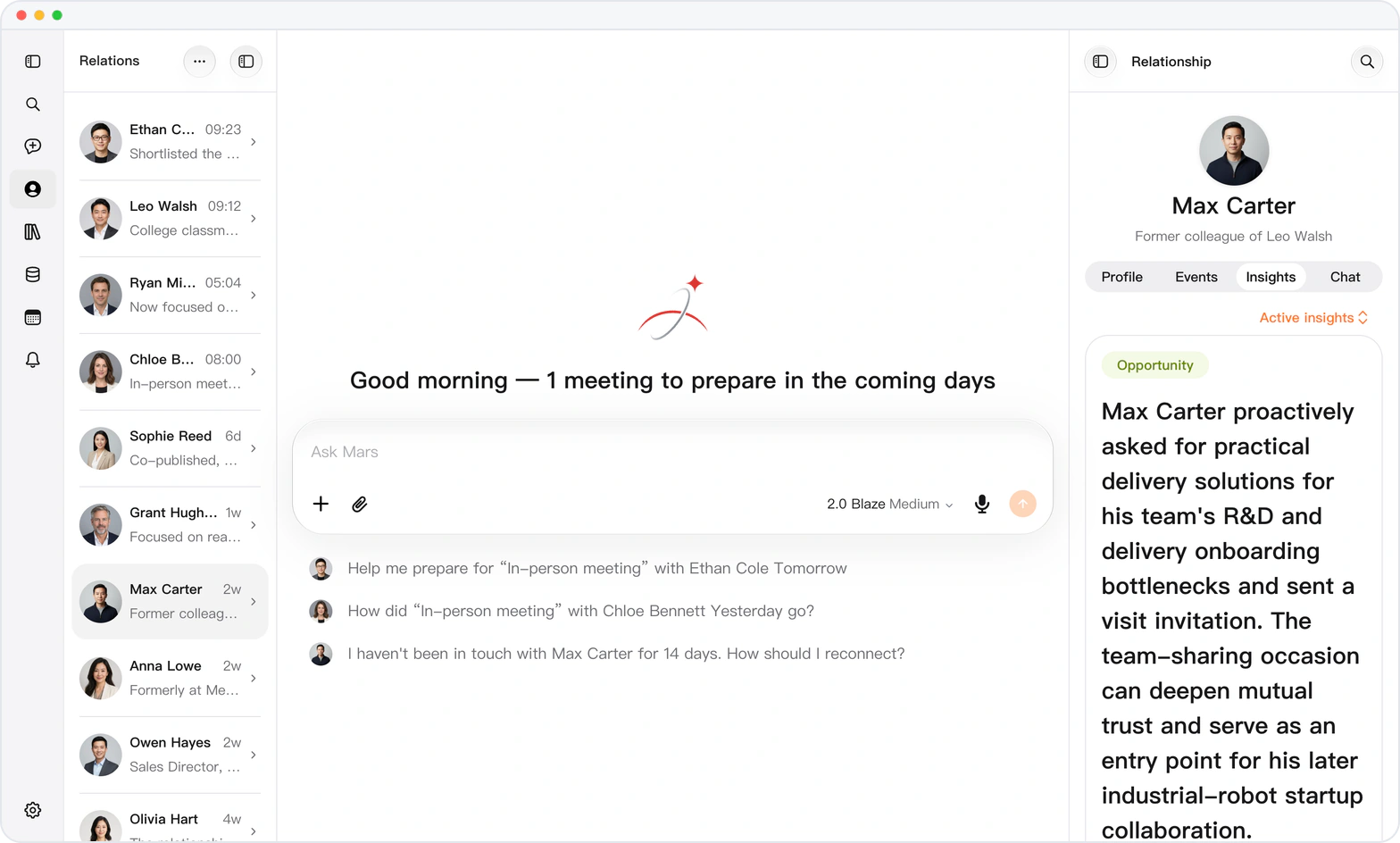
Every FDE engagement has an economic buyer, a technical owner, daily users and someone who can say no. Mars keeps a page for each person you meet at the customer, grouped by business and team, tools and preferences, so the stakeholder map grows from your conversations instead of a spreadsheet.
- Each stakeholder's role, goals and concerns on their own page
- Who reports to whom and who influences the decision
- Notes on what each person cares about before you meet them
Discovery calls that find the real problem
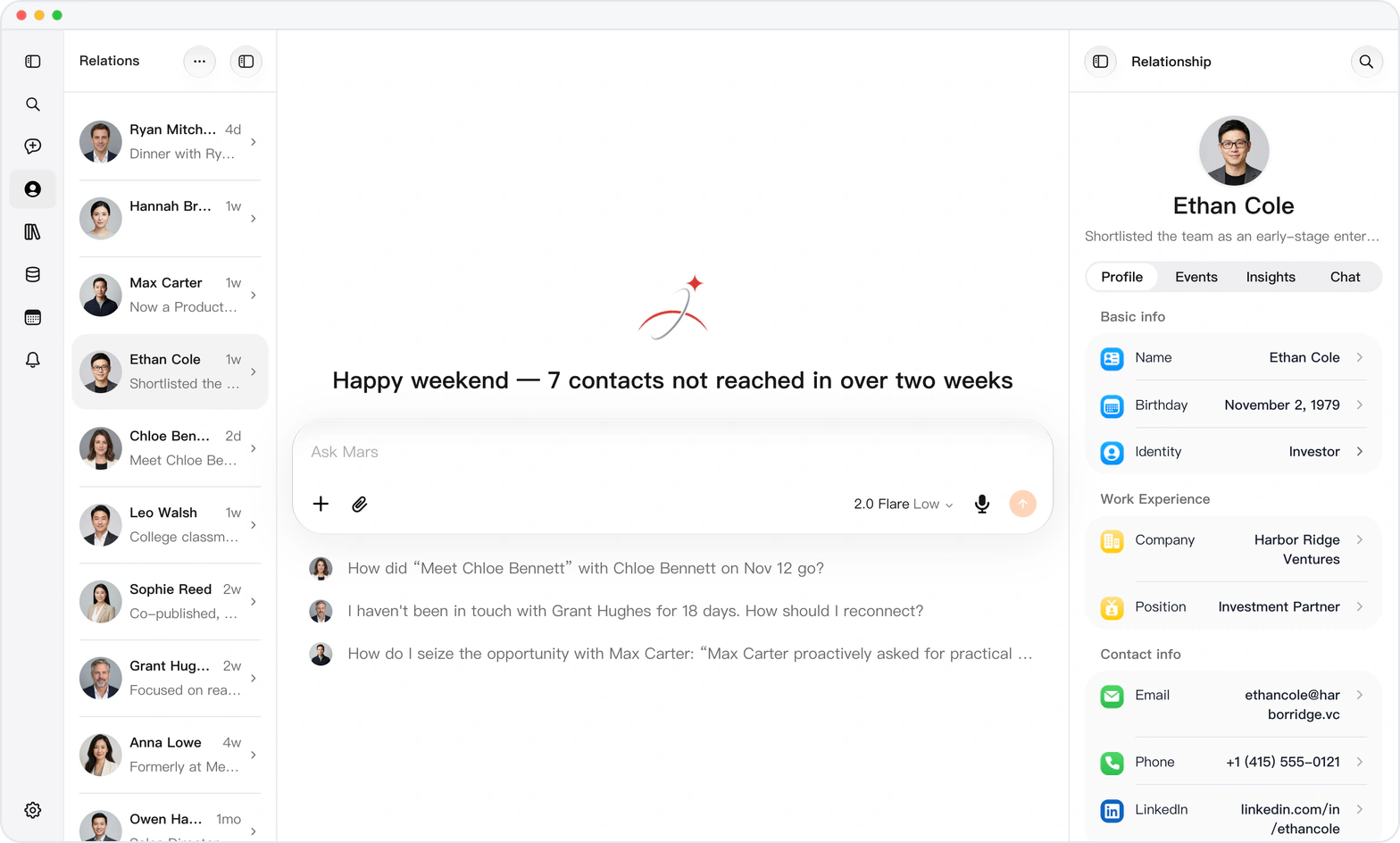
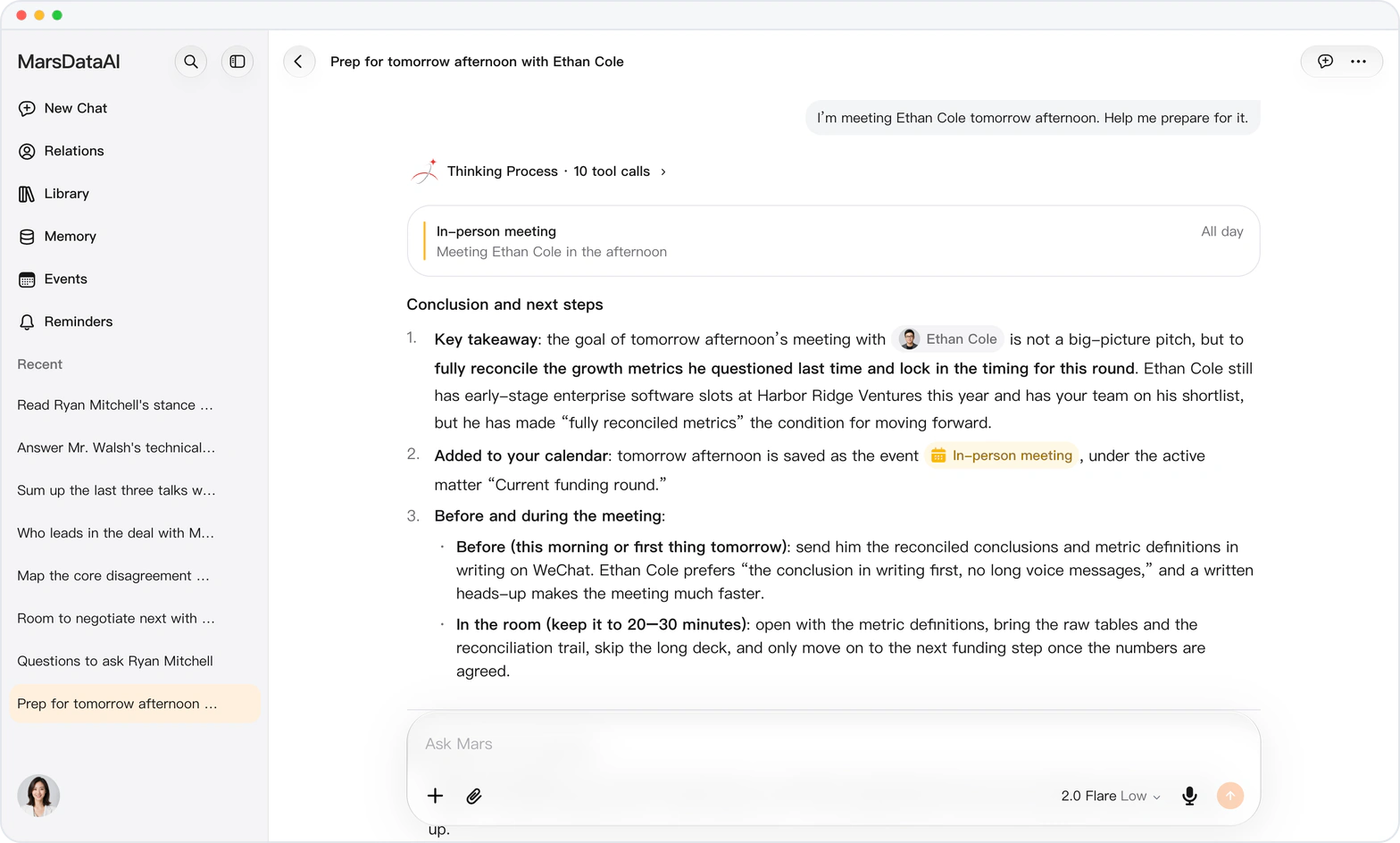
Good customer discovery asks what triggered the project, what success looks like, what data and systems exist and what has already failed. Before each call, ask Mars for a pre-meeting brief built from your saved notes, open needs and past conversations with that person.
- A brief per meeting from your own history with the customer
- Open questions and unresolved needs listed before you walk in
- Follow-up drafts that reference what was actually said
Meeting notes and action items from every site visit
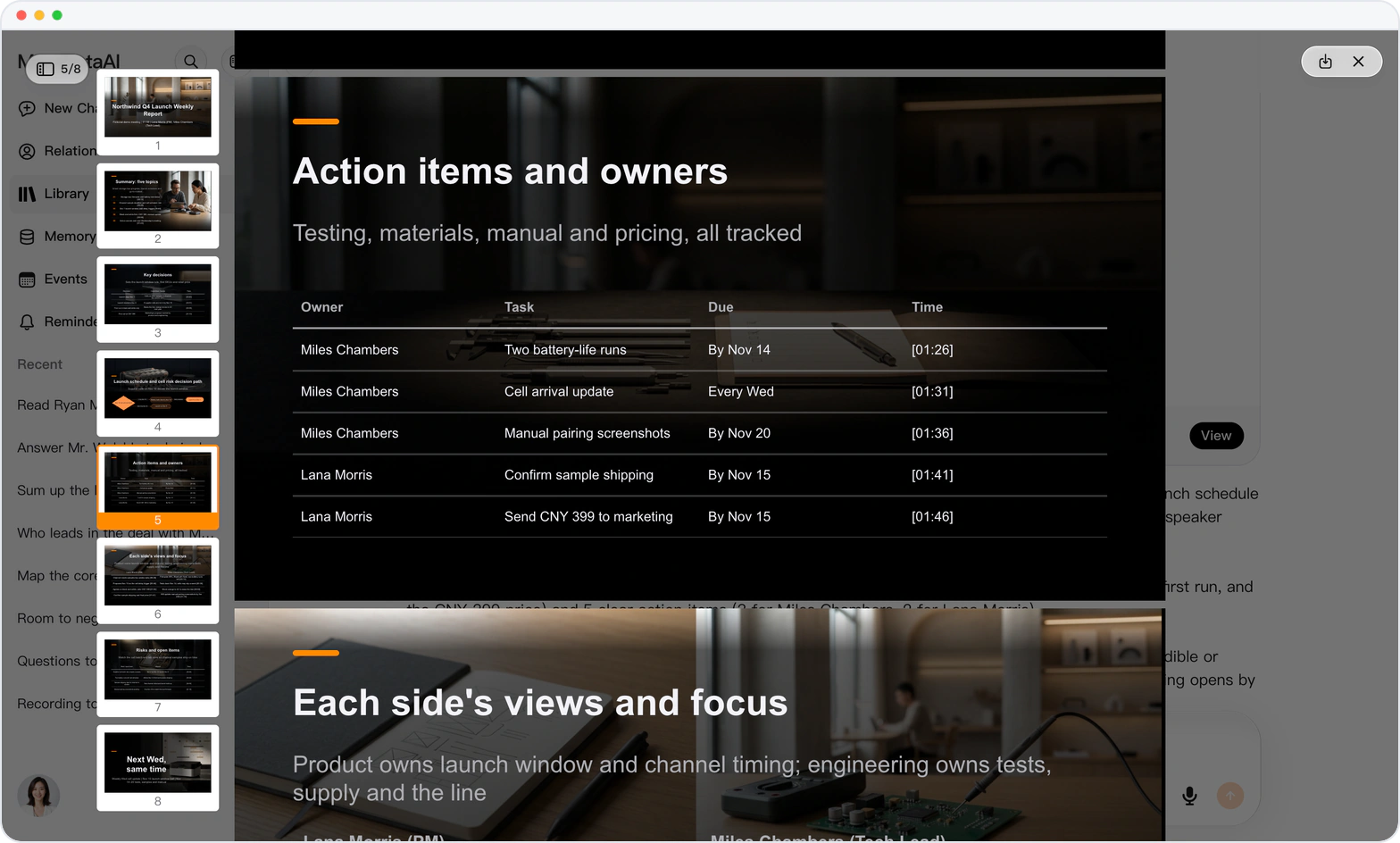
Customer workshops produce promises: I will send the schema, we will open API access by Friday. Record the meeting and Mars lists every action item with owner, task, due date and the moment it was said, and keeps each decision with its conditions.
- Action items with owner and due date, traced to the recording
- Decisions kept with their if-then conditions
- Speakers separated so you know who committed to what
Research the customer before you go on site
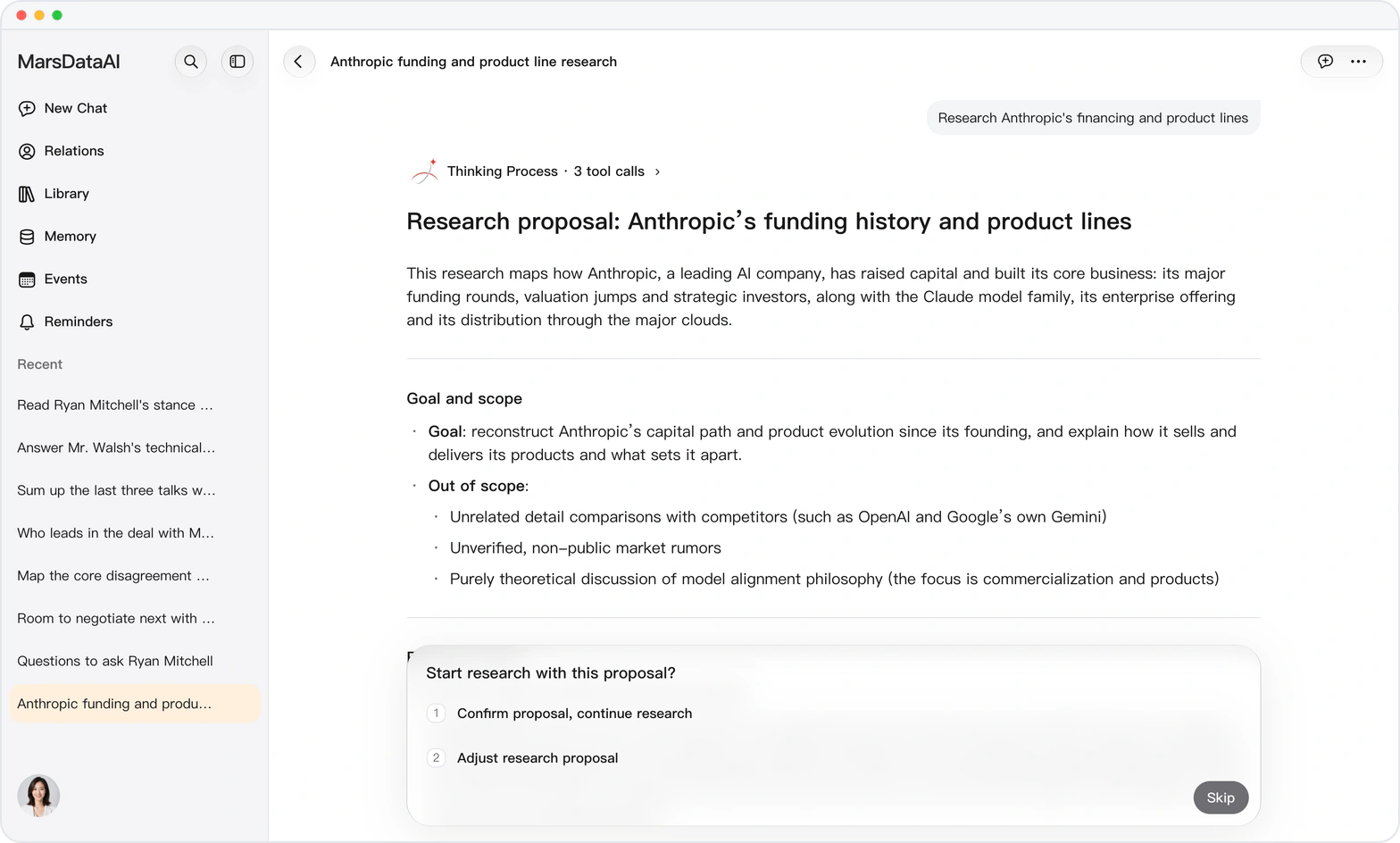
Before the first visit, ask Mars for deep research on the customer company and the people you will meet. It confirms the plan with you, searches in parallel and returns a cited report you can check source by source.
- The customer's business, recent changes and public technical stack
- Background on the people you will meet
- Sources you can open and verify
An FDE client workflow with Mars
- MapAdd each stakeholder you meet; Mars fills in roles and concerns from your chats.
- PrepareGet a research report and a pre-meeting brief before each visit.
- RecordRecord workshops; action items and decisions are listed for you.
- Follow throughEvery promise becomes a reminder and a drafted follow-up.
See the rest of Use cases in MarsDataAI Wiki.